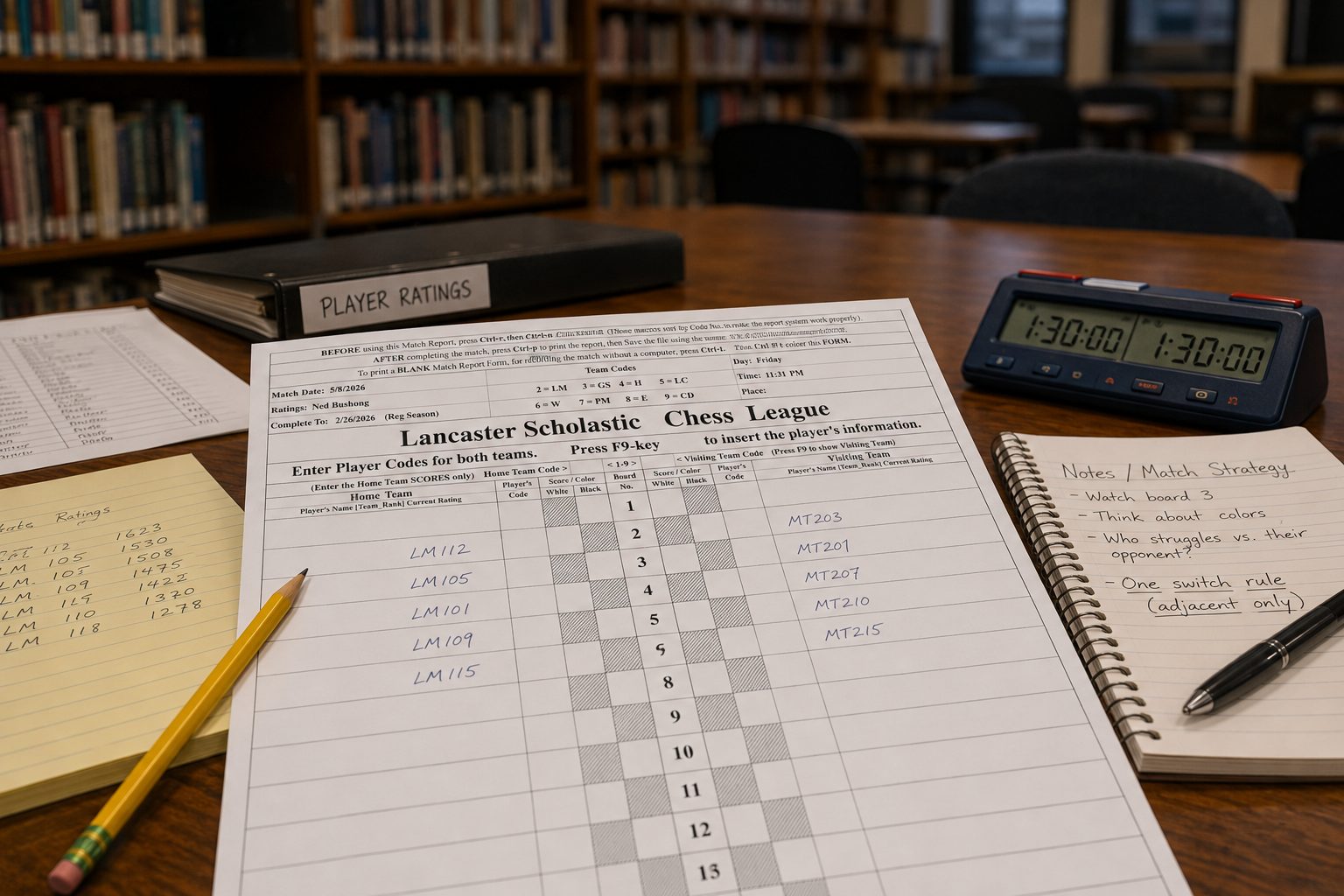
You just got handed the chess team. Congratulations. Here's one of the first things you'll need to figure out: who plays where.
A match in the Lancaster Scholastic Chess League is played across five boards. Your strongest player sits at board one, your second strongest at board two, and so on down to board five. The visiting team plays white on boards one, three, and five. The home team plays white on boards two and four. That's the foundation — everything else builds from there.
Getting your order right
The league uses its own rating system — separate from USCF ratings — to determine board order. Before your first season, the best thing you can do is run a round-robin tournament among your players. Have everyone play everyone. Submit those results to the league, and your players will get initial ratings. Those ratings then determine your lineup for every match going forward.
If you haven't run a tournament yet, rank your players by your best assessment of their strength and go from there. The ratings will sort themselves out as the season progresses.
One important rule for new players: a player must have competed in at least four rated league matches before they can play in your top three boards. This protects both sides — it keeps unrated players from disrupting the competitive integrity of the top boards, and it protects established players' ratings from unexpected results against opponents with no rating history yet.
What happens when players are missing
Life happens. Your board two and board three are both out sick on match day. Now what?
You play your available players in order. If your ranked roster is 1, 2, 3, 4, 5, 6, 7 and boards 2 and 3 are absent, your match lineup becomes 1, 4, 5, 6, 7 — still in order, still your strongest available players at the top. The absent spots aren't filled by moving everyone up; you simply play whoever is there in their correct sequence.
If a team has fewer than five players, the missing boards are forfeited. Fewer than three players available and the match is a forfeit.
The one adjustment you're allowed
Here's where a little strategy comes in. The rules allow one adjacent switch per match — you can swap two players who are next to each other in the rating order. Boards 3 and 4 can switch. Boards 1 and 2 can switch. But only one swap, and only between adjacent boards.
So this works: 1, 2, 4, 3, 5 — boards 3 and 4 have switched.
This does not: 2, 1, 3, 5, 4 — that's two switches at once, boards 1 and 2 plus boards 4 and 5. Not allowed.
Why would you use this? A few reasons. Maybe one of your players performs better with the black pieces and the swap puts them in a better color matchup. Maybe you have a specific opponent in mind — a player on your roster who historically gives a particular opposing board trouble. One switch, used wisely, can change a match.
Building depth: the board five rule
If your team has more than five players, all players ranked below board five are considered tied for that fifth spot. This matters most for younger or newer players who haven't built up a rating yet.
Here's a real scenario: a strong freshman joins the team but has only played a handful of matches. Their rating doesn't reflect their actual ability yet. Because they're considered tied for board five, you can slot them into the varsity lineup and start building their rating. As they accumulate results, their rating climbs, and you can move them up — eventually using that one permitted switch to get them to board four, then board three over time.
It takes patience, but it's the right way to develop players through the system.
The one thing to do before your first match
Run a preseason tournament. Get all your players in a room, have them play each other, and submit the results to the league. It warms players up for the season, helps you figure out who your best five actually are, and gives new players a path onto the roster. It also makes your first lineup decision a lot easier.
When in doubt, keep it simple: rank your players honestly, follow the order, and use your one switch only when you have a real reason to. The board order rules exist to make sure the best players compete against each other. Work with that, not around it.